Is Thuma Worth It? The Five Reasons People Give, Tested
 By Alana Collins

People do not ask is Thuma worth it because they want a bed. They ask because they have seen the price and they are looking for permission.
So here are the five reasons buyers actually give, each one tested against what cheaper beds also do.
The Five Reasons, Scored
| The reason people give | Holds up? | Because |
| Tool free assembly | Partly | Rivals do it too |
| Japanese joinery | Partly | Not unique to them |
| It stays silent | Yes | Cushioned slats, tested |
| Sustainable materials | Partly | Species not published |
| It looks the part | Yes | This is the real reason |
Two hold completely, three only partly.
Three of the five reasons turn out to be things other beds also manage, usually for less. The two that survive are real, and one of them is the honest answer.
Reason One: No Tools

True, and tested. An independent reviewer assembled the frame in under 10 minutes with no tools at all, the pieces simply sliding into one another the way the marketing says they do.
The problem is that this is no longer rare. One cheaper alternative at around $700 builds with a single screw, and another at $850 is toolless with the same design approach.
Tool free is a reason to avoid a flat pack, but it is not on its own a reason to pay four figures when two cheaper beds offer much the same thing. Partly holds.
Reason Two: Japanese Joinery
Also true, and the execution is clean, with the Classic using exposed Japanese joinery while the Essential moves the same joinery inside and adds hand screws.
A cheaper alternative at around $700 is described by a reviewer as looking very similar at about half the cost, using a comparable approach. Another uses the same Japanese design language in acacia.
So the technique is real but it is not proprietary, and the design is widely imitated at lower prices. Partly holds.
Reason Three: It Does Not Squeak
This one holds completely and it is the most underrated thing about the bed frame.
The slats are cushion coated and sit in notches rather than screwing down. An independent tester weighing 270 lb reported no squeaks sitting, bouncing or rolling, with one of the heaviest mattresses they had tested.
A squeaking wooden bed frame is the single most common complaint in this category, and solving it properly is worth paying something for. How much is the question the rest of this article answers.
Reason Four: Sustainable Materials
Partly. This is where we have to be careful.
The brand describes the frame as solid, upcycled wood and it carries GREENGUARD Gold certification for emissions. Both of those are real and verifiable claims.
What the pages we read never state is the wood species. One third party review asserts it is rubberwood, which we are reporting as that publication's claim rather than as fact, because we could not confirm it from the brand.
By contrast one competitor names solid maple or walnut with FSC certification. Naming the species is a low bar and the gap is odd on a bed frame sold on its material.
Reason Five: It Looks Like That
Holds completely. Here is the honest part.
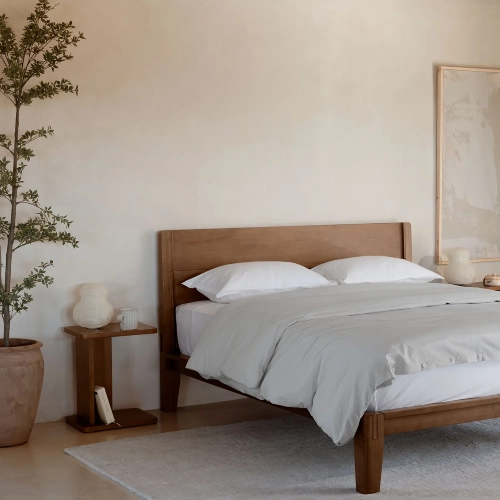
This is the actual reason most people buy it. The bed looks exactly like the photographs, the finish is consistent, and it is a recognisable object rather than a generic frame.
Spending money on how something looks is a perfectly legitimate choice and we are not going to talk anybody out of it, we would simply rather say so plainly than dress a styling decision up as engineering.
What the Cheaper Options Cost
| Cheaper option | Queen | What it is |
| KD Frames Lexington | $294 | Kiln dried tulip poplar |
| Valyou Charm 2.0 | About $700 | Ash, one screw to build |
| Puffy Bed Frame | $849 | Upholstered, uses hardware |
| Silk & Snow Wooden | $850 | Acacia, toolless |
| Thuma Classic | $1,995 | The one in question |
From $294 to $850 against $1,995.
Four named alternatives from a published comparison, all Queen size, all wooden platform beds in broadly the same style.
The cheapest is a kiln dried tulip poplar frame at $294 with minimal hardware and adjustable leg lengths. The nearest look alike is around $700 in ash, though it needs a wall for headboard support and offers only two finishes.
The Gap, in Numbers
| Thuma against each one | How much more |
| Against KD Frames at $294 | 578.6% more |
| Against Valyou at about $700 | 185.0% more |
| Against Puffy at $849 | 135.0% more |
| Against Silk & Snow at $850 | 134.7% more |
| Cheapest gap in dollars | $1,145 |
Between 134.7% and 578.6% more, depending on what you compare it to.
Against the $850 beds, Thuma is 134.7% more. Against the $700 look alike it is 185.0% more. Against the $294 frame it is 578.6% more, a difference of $1,701 on a Queen.
Those are not small percentages. No amount of joinery talk makes them small.
The Cost Per Year Test
| Cost spread over time | Per year |
| Thuma over 5 years | $399.00 |
| Thuma over 10 years | $199.50 |
| Thuma over 20 years | $99.75 |
| KD Frames over 10 years | $29.40 |
| To match it on cost per year | Thuma must last 67.9 years |
$199.50 a year over a decade, against $29.40 for the cheapest rival.
The usual defence of an expensive bed frame is that it lasts long enough to justify itself, so rather than take that on faith we ran the cost per year across three realistic ownership periods and put the cheapest rival beside it.
Over five years Thuma costs $399.00 a year, over ten years $199.50, and over twenty years $99.75. The $294 frame over ten years costs $29.40 a year.
For the cost per year to match, Thuma would have to last 67.9 years against the cheaper frame's ten. That is not a realistic ownership period, which means the durability argument does not close the gap on its own.
What does close part of it is resale, because a recognisable brand holds secondhand value in a way an unbranded frame does not. We have not quantified that and will not pretend to.
- Work out your own cost per year before ordering
- Order the cheaper look alike first if you are unsure
- Check slat spacing against your mattress warranty
- Ask which products the lifetime warranty covers
What You Still Do Not Get
| What the extra money buys | Honest answer |
| A quieter bed | Yes, cushioned slats |
| Faster assembly | Under 10 minutes, tested |
| A specific look | Yes, and it is the point |
| Published weight capacity | No, none stated |
| A named wood species | No, not on the pages we read |
| Clear warranty scope | No, select products only |
A quieter, faster, better looking bed, but three gaps in the published detail.
Three things are missing from the published material and all three matter at this price. There is no stated weight capacity anywhere we could find, no named wood species, and the lifetime warranty applies to select products without the pages saying which.
None of that means the bed is poorly made. The testing suggests the opposite. It does mean you are buying partly on trust, and trust is a far easier thing to extend to a $294 frame than to one costing nearly two thousand dollars.
And the Costs After the Bed
| The costs after the bed | Price |
| Classic Bed, Queen | $1,995 |
| Essential Bed, Queen | $2,395 |
| White Glove Delivery | $295 |
| Classic delivered that way | $2,290 |
| Free shipping threshold | $1,000, cleared either way |
White Glove adds $295, taking a Classic Queen to $2,290.
Shipping is free over $1,000 so the bed clears that alone. White Glove Delivery is $295, which takes a Classic Queen to $2,290 and an Essential to $2,690.
One note on sources. Some published reviews quote Thuma Queen prices well below the $1,995 on the brand's page today. That most likely reflects pricing changes since those reviews were written, but we cannot verify it, so we have used the brand's current figure throughout and flagged the discrepancy here.
So When Is It Worth It?
| Worth it if | Not worth it if |
| You move house often | The bed never moves |
| You want it today | You can wait and save |
| The look is the purchase | Nobody sees the bedroom |
| You hate flat pack | One screw does not bother you |
| Resale matters to you | You keep things forever |
Movers, impatient buyers and people buying the look.
Worth it if you move often, because tool free assembly and reassembly genuinely saves hassle every single time you do it, and a flat pack frame rarely survives three moves intact. Worth it if the look is the purchase. Worth it if you want it this week, since the Classic ships in one to three business days.
Not worth it if the bed will sit in one room for a decade and nobody but you sees it. In that case a cheaper alternative at $294 to $850 does the same job and the difference buys a mattress, which affects your sleep considerably more than the frame under it.
Final Verdict
| Category | Score |
| Build Quality And Silence | 9 / 10 |
| Assembly Experience | 9.5 / 10 |
| Design Appeal | 9 / 10 |
| Transparency On Specs | 4 / 10 |
| Value Against Rivals | 4.5 / 10 |
| Overall Score | 6.5 / 10 |
Six and a half out of ten on value, which is a lower score than the bed frame itself deserves. The product is good, the assembly is genuinely excellent at under 10 minutes with no tools, and the cushioned slats solve squeaking properly. The problem is the gap. At $1,995 for a Queen it is 134.7% more than two comparable beds at $850 and 578.6% more than a $294 one, and the cost per year arithmetic does not rescue that, since it would need to last 67.9 years to match the cheapest rival over ten. So the answer to is Thuma worth it is yes if you are buying the design and the convenience and you know that is what you are buying. If you want a quiet wooden bed frame, cheaper options get you most of the way for a fraction.
FAQs
Is Thuma overpriced?
Against comparable wooden platform beds, it costs 134.7% to 578.6% more. Whether that is overpriced depends on how much you value the design and the assembly.
What is the cheapest Thuma alternative?
A published comparison names a kiln dried tulip poplar frame at $294 for a Queen, with a similar shape and minimal hardware.
How long does a Thuma bed last?
The brand does not publish a weight capacity or expected lifespan, and we have no durability data. Its warranty is stated as lifetime on select products without naming which.
Does Thuma squeak?
Not in independent testing. The slats are cushion coated and a 270 lb tester reported no noise sitting, bouncing or rolling.
What wood is Thuma made of?
The brand says solid, upcycled wood and does not name the species on the pages we read. One third party review asserts rubberwood, which we could not confirm.
Is White Glove Delivery worth $295?
Only if stairs or access are an issue. The frame assembles in under 10 minutes without tools, so the delivery upgrade is about carrying rather than building.
Do you agree with our review?
Comments (0)
All comments are reviewed and approved by an admin before appearing publicly.
No comments yet - be the first to share your thoughts.
Ask a Question
Got a question about this review or the brand? Ask below - our team answers what we can, and it'll appear here for other readers too.