DeerRun Review: What a $459 Treadmill Gives Up
 By Alana Collins
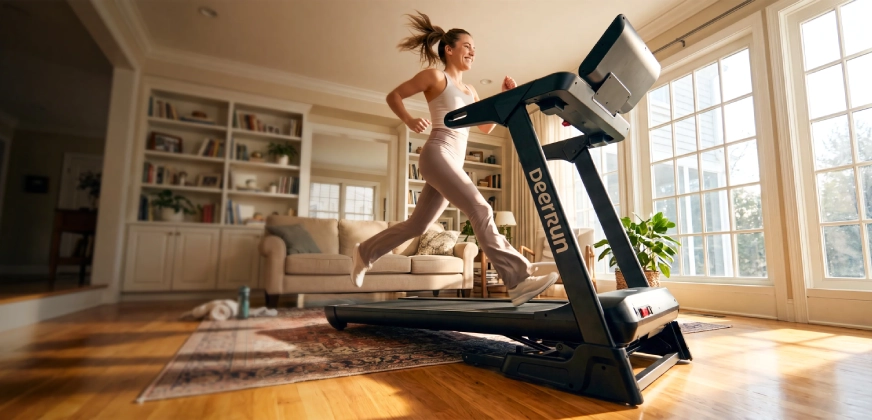
Every cheap treadmill is a set of trade-offs, and the honest job of a review at this price is to say which ones were made. Nobody expects a $459 machine to match a $2,000 one. What matters is whether the compromises sit in places you will notice.
For this DeerRun review we worked from an independent publication that measured the A1 Pro rather than from the spec sheet, and three of the compromises are worth knowing in detail before you buy.
The headline specification
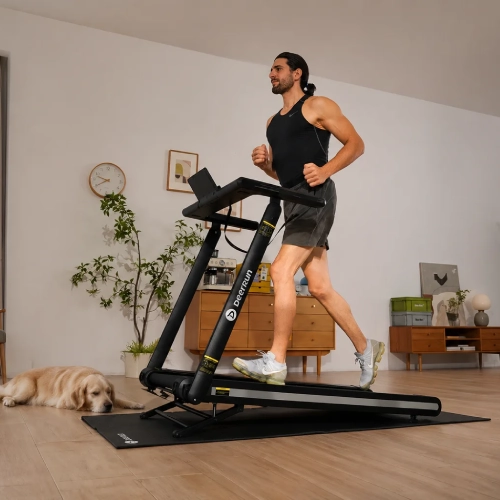
| Spec | Figure | Comment |
| Price | $459 MSRP | Entry level |
| Motor | 3.0 HP | Peak or continuous not stated |
| Running deck | 16.5 x 44 in | 726 square inches |
| Deck thickness | 0.5 in | 0.75 to 1 in is typical |
| Top speed | 10 mph | 7.5 mph on the tabletop version |
| Incline | Manual, flat to about 6% | Reviewer measured about 5% |
| Weight capacity | 350 lb | Generous for the price |
| Folded height | about 8 in | Slides under furniture |
| Warranty | 1 year | Below cardio industry norm |
The deck is where the money went missing
Two deck figures matter and both are below the running treadmill norm.
The running deck measures 16.5 by 44 inches, which is 726 square inches. A full running treadmill is usually nearer 20 by 55 inches, or 1,100 square inches, so this running deck is about 34.0% smaller in area. The reviewer specifically notes the deck is narrow and that this can make balance harder.
The thickness is the more structural issue. The deck board measures 0.5 inches where 0.75 to 1 inch is typical, which is 33% to 50% thinner. The reviewer's own warning is that it may be more prone to cracking under high-intensity use.
Deck thickness is not a vanity spec. The board is what absorbs every footfall, and a thinner board flexes more, transmits more shock to your joints and has less material to crack through. On a machine rated to 350 pounds, a half-inch deck is the component we would worry about first, and it is the one nobody checks before buying.
Put those two together and the picture is consistent. This is a walking machine with a running top speed, not a running machine that also walks.
Thirty-two seconds to top speed
The reviewer timed the machine from 0.6 to 10 mph and it took 32 seconds. That works out at about 0.29 mph of acceleration per second.
That figure tells you the 10 mph headline is nominal rather than usable. If you want to run intervals, half a minute of ramp-up means the interval is over before the belt arrives at pace. The reviewer says they felt most comfortable at 7 mph or less and advises caution with speed increases.
So the realistic speed range of this folding treadmill is walking to a steady jog. Treat the top number as the limit of what the motor can do rather than a speed you will train at.
The incline you cannot change mid-workout
Incline is manual, advertised to about 6%, and the reviewer measured roughly 5% on their unit, which is 16.7% below the claim.
More importantly, it has to be set with the treadmill switched off. You cannot adjust it during a session, which rules out hill intervals and rules out the gradual incline walking that is the main reason many people buy a treadmill at all.
If incline training is your goal, this is the wrong machine regardless of price, and that is a specification point rather than a criticism of value.
The folding mechanism needs a tool
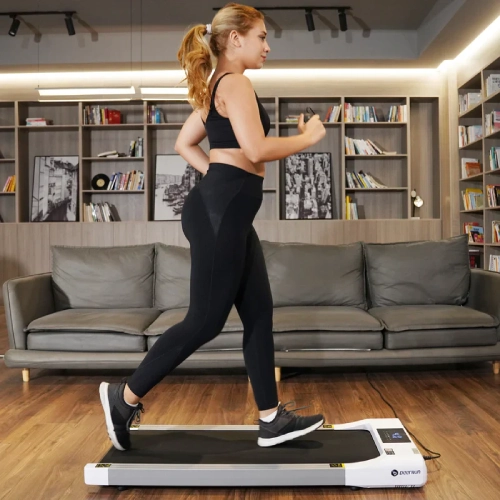
This is sold as a folding treadmill, and the folded height of roughly 8 inches is genuinely useful. It slides under a sofa or a bed, which is the whole point.
The catch is how you get there. The reviewer reports that folding and unfolding the uprights requires an Allen wrench and adjusting a bolt on each side, which becomes tedious with frequent use.
A folding treadmill you fold once and then leave folded is fine. A treadmill you intend to fold daily, which is the normal use case in a small flat, needs to fold in one movement. Anybody buying for a shared living room should decide whether they will genuinely fetch a wrench every evening, because most people will stop after a fortnight and leave it out.
Noise, and the console
Measured noise ran from about 49.5 to 65 dB, which the reviewer describes as slightly louder than pricier treadmills. Sixty-five decibels is roughly the level of a loud conversation, so it is television-over-the-top territory in a flat and probably audible through a floor.
The phone rack is small and the console shakes, so it works best with smaller devices. Minor, but if you run with a tablet propped on the console, check the fit first.
Frequently asked questions
Can you actually run on a DeerRun treadmill?
At a steady pace, yes. The reviewer recommends it for walking and light running and does not recommend it for sprinting, citing the narrow deck, the half-inch board and the 32 second ramp to top speed.
Is 3.0 HP enough?
Three horsepower would be ample if it is a continuous rating, and modest if it is a peak rating. The material we read did not specify which, and in this price bracket peak figures are common. That is the question to put to the seller before buying.
Is the warranty any good?
One year, which the reviewer notes is below the industry standard for cardio machines. Treadmills are motors, belts and boards under repeated load, so a one year term on a machine you intend to use daily is the main value reservation here.
Who is it right for?
Someone who wants to walk several miles a day indoors, has limited space, and will mostly leave the machine set up. At $459 with a 350 pound capacity and an 8 inch folded height, it does that job at a price very little else matches.
Who should avoid it?
Runners, interval trainers, anyone who wants incline during a workout, anyone needing to fold it daily without tools, and anyone in a flat with thin floors and sensitive neighbours.
The verdict
At $459 this is a reasonable walking machine with a generous 350 pound capacity and a genuinely slim folded profile. Those are real strengths and the price is low enough that the compromises are not unreasonable.
What this DeerRun review would want you to carry into the decision is the half-inch deck and the 32 second ramp. Those two numbers define what the machine is, and they are not in the marketing. A 0.5 inch board under a 350 pound rating, with a running deck 34.0% smaller than a full-size one, is a walking pad with a fast setting rather than a treadmill that happens to be cheap.
So buy it to walk on, which is what it is built for. Ask whether the 3.0 HP figure is continuous or peak. And if you genuinely need to fold it every day, pick something with a gas-strut hinge instead, because an Allen wrench twice a day is a habit nobody keeps.
Do you agree with our review?
Comments (0)
All comments are reviewed and approved by an admin before appearing publicly.
No comments yet - be the first to share your thoughts.
Ask a Question
Got a question about this review or the brand? Ask below - our team answers what we can, and it'll appear here for other readers too.