
Disclosure: Coco n Deals may earn a commission if you buy through links on this page, at no extra cost to you. I only review products I’ve independently researched.
Smart rings have a pricing problem nobody in the industry likes discussing. You pay several hundred dollars for the hardware, and then you keep paying every month to read your own data. Oura built a category on that model. Ultrahuman looked at the same market and made a different bet: charge exactly the same $349 for the ring, and don’t charge a monthly fee for the core experience. That’s a genuinely interesting argument — but only if the ring is good. So this Ultrahuman Ring Air review is really about one question: does the hardware earn the comparison, or is “no subscription” just a discount on something you’d rather not wear?
What Is the Ultrahuman Ring Air?
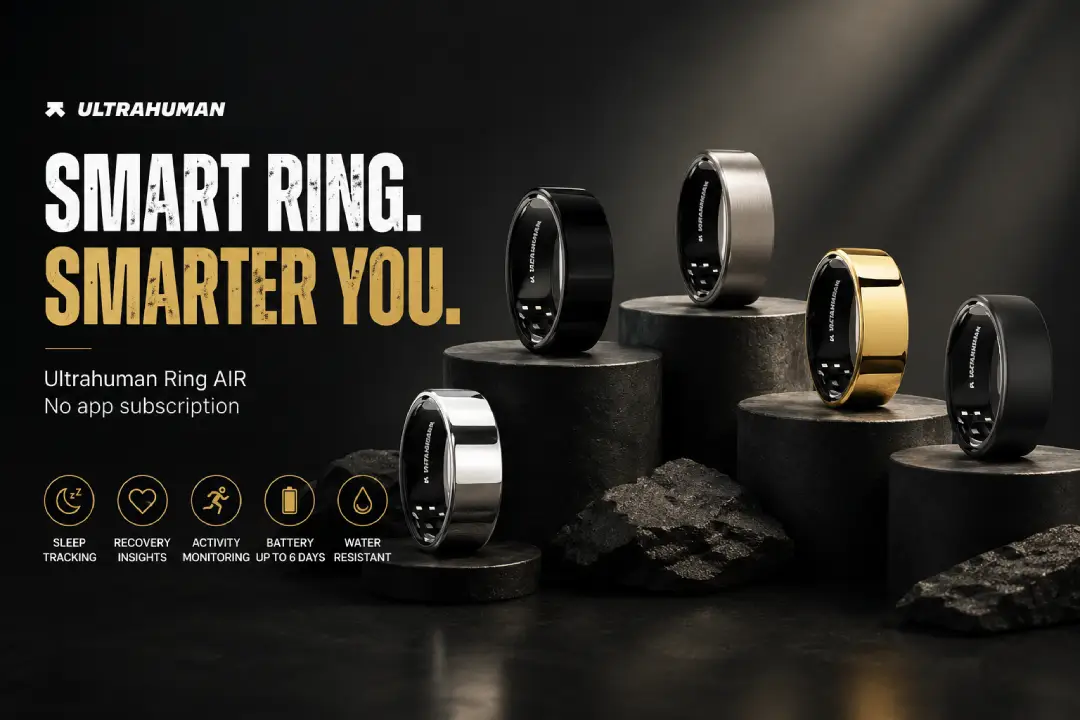
The Ring Air is a $349 smart ring tracking heart rate, skin temperature, activity, workouts and stress, with automatic detection of sleep, naps, and some exercise like outdoor walks. You can start workouts or breathing sessions manually — there are dozens of profiles — and log food and water. The hardware is the headline: 2.4 to 3.6 grams, 2.45 to 2.8mm thick, one of the lightest smart rings on the market. Battery runs up to six days, it’s water resistant to 100 metres for up to 12 hours, sizes run 5 through 14, and it works with iPhone and Android. The app surfaces scores for sleep, dynamic recovery, movement index, stress rhythm and circadian rhythm. And the commercially important part: no monthly subscription for the core experience.
What the Ring Air Gets Right
- The subscription maths: $349 buys the ring and the tracking. There’s no recurring fee to see your own numbers — over three or four years, that gap compounds into real money against a subscription rival at the same sticker price.
- It genuinely disappears on your finger: 2.4–3.6 grams and under 3mm thick — a tester who has worn several smart rings called it the lightest and most comfortable he’d tried.
- Six days between charges: long enough that charging becomes a weekly chore rather than a nightly interruption — which matters, because a ring off the charger is a ring collecting sleep data.
- Properly swim-proof: 100 metres of water resistance for up to 12 hours — you never take it off, which is the entire point of a ring over a watch.
- It acts instead of just reporting: stretch reminders, the ideal window to drink caffeine, the best time to exercise for your circadian rhythm — it pushes suggestions rather than leaving you to interpret graphs.
Ultrahuman vs Oura Ring: Which One Is Actually for You?
Both rings cost $349. That makes the Ultrahuman vs Oura Ring decision refreshingly clean — it isn’t about budget, it’s about temperament. Work down this table and you’ll know within about thirty seconds.
| If you… | Then choose | Why | Watch out for |
|---|---|---|---|
| Hate recurring fees | Ultrahuman | No core subscription | Paid add-ons exist |
| Want a polished app | Oura | Ring Air’s app is cluttered | You’ll pay monthly |
| Want habit nudges | Ultrahuman | Active, suggestion-led | Notifications add up |
| Want the lightest ring | Ultrahuman | 2.4–3.6g, under 3mm | Sizes 5–14 only |
| Need ECG | Neither | Ring Air has no ECG | See a doctor instead |
The philosophical split is the real story. Ultrahuman takes an active approach: it wants to change what you do today, not just report yesterday. If you enjoy getting into the weeds with your data, that’s the feature. If you’d rather glance at a score and get on with your life, those same notifications become noise — and Oura’s calmer presentation suits you better.
What to Buy
1. Ultrahuman Ring Air — $349
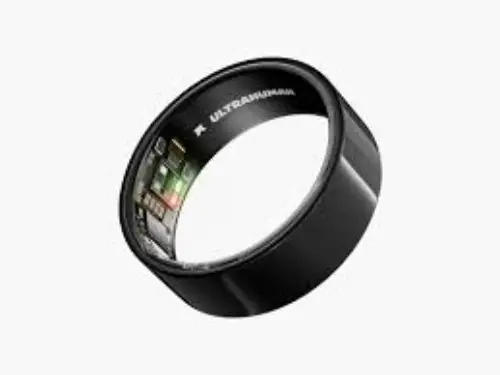
The ring itself, in finishes including raw titanium. Sizes 5–14, six-day battery, 100m water resistance, iPhone and Android. The whole product, with no subscription required to use it.
2. The Sizing Kit — order this first
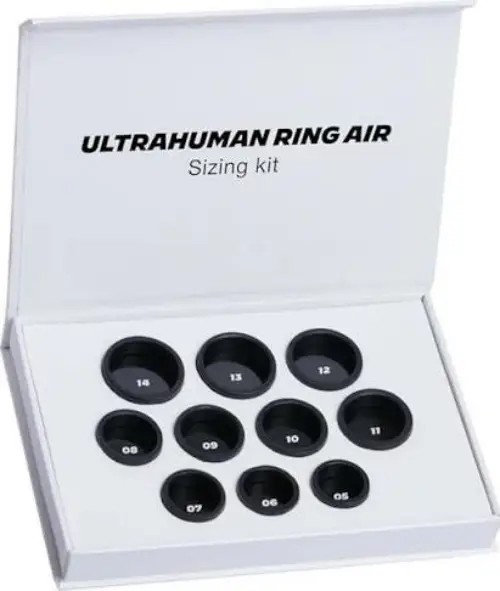
Not optional, and not a formality: a ring cannot be resized after purchase. Ultrahuman ships a sizing kit before the ring for exactly this reason. Wear the sizer for a full day — fingers swell in heat and shrink in cold, and a ring that fits at 9am can rotate at 9pm.
3. The Paid Add-Ons — skip them at first
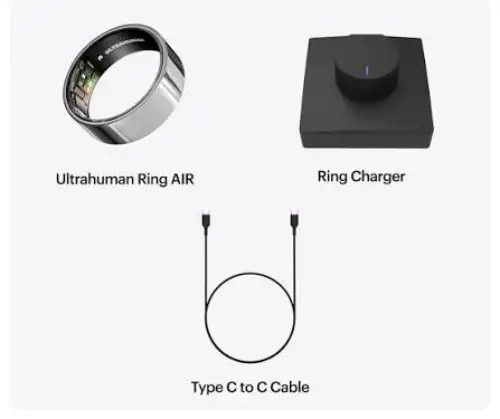
Ultrahuman sells extra app features for a monthly fee. A two-month tester’s honest read was that they feel like extras rather than the core experience — so buy the ring, live with the free tier, and only add on if you find yourself missing something specific.
What Two Months of Testing Found
The comfort verdict is unambiguous. A reviewer who wore the Ring Air daily for two months — removing it only to charge — while simultaneously wearing an Oura Ring 4 and an Apple Watch Series 10 found it lived up to its name: light and comfortable, noticeably more so than other smart rings he’d tried. The tracking is deep: automatic sleep and nap detection, dozens of workout profiles, stress and circadian scoring, and a stream of prompts through the day. His summary — feature-rich with robust tracking — is the right one.
Now the honest half. That same reviewer’s main criticism was the app: it could use tidying up. It’s dense with charts, graphs and competing scores, and there’s a real gap between having a lot of data and presenting it well — the Ring Air sits on the wrong side of it. Two more things before you order. There’s no ECG, so if heart-rhythm monitoring is what you’re shopping for, this is the wrong device. And sizing is permanent: get the kit, wear it a full day, don’t guess. One broader point about every device in this category — the scores are wellness signals, not medical findings. Useful for spotting your own patterns; not a reason to diagnose yourself. Anything that actually worries you belongs in front of a doctor, not an app.
The Social Media Story
Ultrahuman lives in the quantified-self corner of the internet — sleep-optimisation accounts, the recovery-score community, people who genuinely will move their coffee an hour earlier because an app said so. Its content leans into that: circadian timing, caffeine windows, recovery protocols. The subscription-free positioning does quiet work there too, because that community is precisely the audience most irritated by paying rent on their own biometrics. It’s not a mass-market brand and doesn’t behave like one.
My Verdict: Is the Ring Air Worth $349?
Yes — for the person who wants to do something with the data. This Ultrahuman Ring Air review lands on a clear recommendation: it’s the lightest ring in the category, it runs six days, it survives swimming, and at the same $349 as its subscription-charging rival it stops billing you the moment you’ve paid. The trade is an app that hasn’t caught up to its own ambition and a notification style that will divide people. Buy it if you like tinkering with your habits and hate recurring fees. Skip it if you want serene simplicity, or if you need ECG. Order the sizing kit first — that part isn’t optional. Comfort: 5/5. Battery: 4.5/5. App polish: 3/5. Value without a subscription: 4.5/5.
FAQs
Does the Ultrahuman Ring Air have a subscription?
Not for the core experience — $349 buys the ring and its tracking outright. Ultrahuman does sell optional extra app features monthly, but a long-term tester found they feel like genuine extras rather than something you need.
Ultrahuman vs Oura Ring — which is better?
Both are $349. Ultrahuman wins on no core subscription, lighter weight, and active habit nudges; Oura wins on app polish and a calmer, more passive experience. Choose by temperament, not budget.
How long does the Ring Air battery last?
Up to six days per charge, so charging is a weekly task rather than a nightly one. It’s water resistant to 100 metres for up to 12 hours, so you can keep it on for swimming and showers.
Does the Ultrahuman Ring Air track blood pressure or do ECG?
No. It tracks heart rate, skin temperature, sleep, activity, and stress — there’s no ECG. It’s a wellness tracker, not a medical device, and it isn’t designed to diagnose anything. For heart-rhythm concerns, speak to a doctor.
