
Disclosure: Coco n Deals may earn a commission if you buy through links on this page, at no extra cost to you. I only review products I’ve independently researched.
Small-kitchen cooking has one universal enemy: the cabinet where pots go to fight. Every apartment dweller knows the sound — the avalanche when you reach for the saucepan. Alva, a Belgian cookware house that’s been around since just after World War II and only landed in the US in 2022, built the Neat set as a direct answer: five pieces that nest into a stack claiming to take no more room than a single Dutch oven. It’s a genuinely clever idea, and clever ideas in cookware usually come with a catch. This Alva Neat nesting set review digs into whether the stacking gimmick survives real cooking, what the coating situation actually is, and the one thing about this brand you should know before ordering.
Why Trust This Review
Coco n Deals reviews are independent — no brand pays for a verdict here. For this article I worked through Taste of Home’s three-month editor test of the Neat set, LeafScore’s multi-year staff testing of Alva’s lines, the brand’s Trustpilot record including the negative reviews, and Alva’s published specifications. Everything I’ve reviewed lives in my reviews archive.
What Is the Alva Neat Set?
The Neat is a 5-piece nesting cookware set built for tight spaces: a frying pan, a 2-quart saucepan, a stock pot, and two lids (6-inch and 8.5-inch) that assemble into one compact stack. The trick is smarter than it sounds — the saucepan sits inside the stock pot with its handle poking through the pot’s pour spout, the lids layer on, and the frying pan caps the tower. Alva ceramic non-stick coats the cooking surfaces: PFAS-, PTFE-, and PFOA-free, over an aluminum core, induction-compatible and oven-safe. The brand behind it has real history — founder Albert Vandaele started melting down old materials into cookware in post-war Belgium, and the sustainability angle has stuck around ever since (recyclable packaging, recycled aluminum cores). Notably for coated cookware, Alva backs its ceramic non-stick lines with a 10-year warranty against the industry-standard 1-to-2 years, and its all-stainless lines with 25.
What the Neat Set Gets Right
- The stacking genuinely works: Taste of Home’s editor — a self-described cookware hoarder — tested it for three months and confirmed the whole set tucks into a single cabinet corner.
- A 10-year coated warranty: ceramic non-stick usually ships with a 1-year promise; ten years is Alva quietly betting on its own coating, and it’s the most persuasive spec in this review.
- Weight that’s actually right: testers describe it as “not flimsy, not heavy” — the balance small-kitchen cooks and RV owners actually need.
- Certified-clean coating: PFAS-, PTFE-, and PFOA-free ceramic over an aluminum core, induction and oven compatible — the full non-toxic checklist without the compromise on cooktops.
- Packaging that respects you: no glue-residue labels to scrub off, fully recyclable materials, FSC-certified board — small things that signal a brand paying attention.
The Alva Lineup: What to Buy
1. Neat 5-Piece Nesting Set — the space-saver
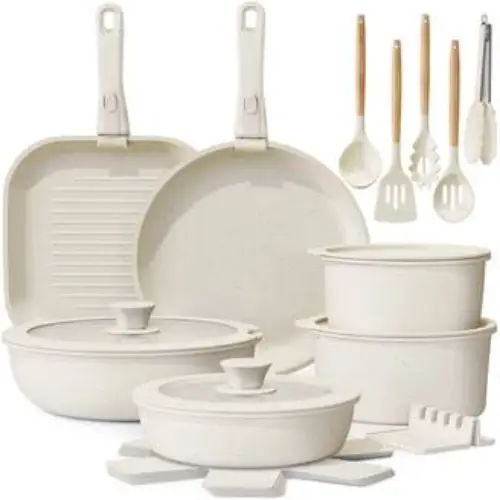
Frying pan, 2-quart saucepan, stock pot, two lids — nesting into one stack. Green, black, or peach. The set this Alva Neat nesting set review is built around, and the right call for apartments, RVs, and tiny kitchens.
Check current price → https://alva-cookware.us
2. Maestro 2-Piece Set — the minimalist core
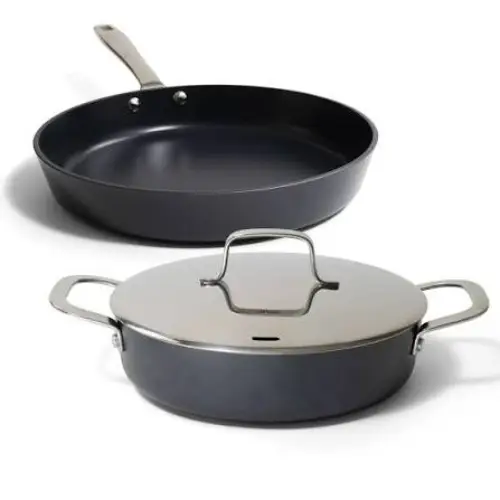
A 4-quart sauté pan and 4.5-quart stock pot with the scratch-resistant ceramic coating and stay-cool stainless handles. Note it’s hand-wash only — and read the customer section below before you buy this line specifically.
Check current price → https://alva-cookware.us
3. Nori Enameled Cast Iron — the style pick
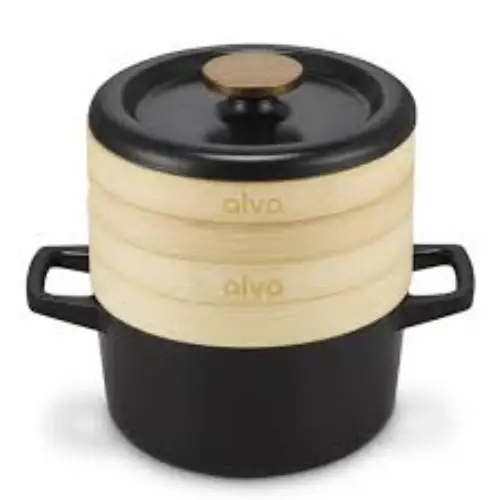
Black enameled cast iron with bronze knobs and three thick enamel layers — oven-safe to 392°F, works on induction, hand-wash only. The Nori mortar and pestle runs $79 if you want a low-cost taste of the line.
Check current price → https://alva-cookware.us
What Real Owners Say — Including the Split
The Neat set earns its praise honestly. Taste of Home’s editor challenged herself to cook only with it for a month — boiling water, simmering soups, stirring Rice Krispies treats in the stock pot — and came away impressed with the stacking system and the build. LeafScore’s reviewer, who’s used Alva for years and is used to banging cast iron around without care, reported that after almost daily use for a year her ceramic Maestro pan still looked almost brand new. On the brand fundamentals — Belgian heritage, sustainability transparency, chef-quality construction at mid-range prices — the independent coverage is consistently positive.
Now the honest split, because a useful Alva Neat nesting set review has to name it. Alva’s Trustpilot profile sits at 3.9 from a very small sample, and the reviews there are genuinely divided: one owner three months into a Maestro pan on induction calls it the best pan he’s owned — even heating, never sticks, excellent third-party non-toxic ratings — while another reports his $150 Maestro sticking with eggs unless he uses butter. A third praises the product and slams the service over a free-shipping threshold dispute. LeafScore flags the same pattern: Amazon reviews for the Maestro non-stick line “haven’t been stellar for at least a year,” and the reviewer has asked Alva directly whether manufacturing changed — and whether the solar-energy and water-filtration claims cover its Chinese facilities as well as the Belgian ones. My read: the Neat set and the stainless lines are the safer buys; the Maestro non-stick line is where the complaints concentrate. And the eggs-need-butter complaint isn’t really a defect — ceramic always wants a little fat, as I covered in the
GreenPan Valencia Pro review in this collection — but at $150 a pan, expectations run high, and Alva’s marketing doesn’t manage them.
The Social Media Story
Alva’s content leans on the two things it genuinely owns: the post-war Belgian origin story (a founder melting scrap into pots is a better tale than any launch campaign) and the nesting demo, which is inherently watchable — five pieces collapsing into one stack is the kind of clip small-space TikTok exists for. It hasn’t chased viral colorway culture like the pastel brands, and its US footprint since 2022 is still building. That works in a buyer’s favor right now: this is a brand still winning people over on function rather than coasting on fame.
My Verdict: Is the Alva Neat Set Worth It?
Yes — if your problem is space. This Alva Neat nesting set review lands on a clear recommendation: for apartments, RVs, and cramped kitchens, the nesting design is a genuinely tested solution (three months of editor use says so), the ceramic is properly certified, and that 10-year coated warranty is the most confident promise in the category. My caution is aimed elsewhere in the catalog: the Maestro non-stick line carries a real cluster of complaints, and the brand’s customer service draws sharp criticism when things go wrong. Buy the Neat for the stack, use a little fat on ceramic, hand-wash it, and keep your receipt. Space-saving: 5/5. Coating & certification: 4/5. Warranty: 4.5/5. Customer service: 2.5/5.
FAQs
Does the Alva Neat set really nest together?
Yes — the saucepan sits inside the stock pot with its handle through the pour spout, the lids layer on, and the frying pan tops the stack. An editor who tested it for three months confirmed it stores in a single cabinet corner.
Is Alva ceramic non-stick safe?
The coating is PFAS-, PTFE-, and PFOA-free over an aluminum core, and owners cite good third-party non-toxic ratings. Like all ceramic, it needs a little oil or butter and no metal utensils — and Alva backs it with an unusual 10-year warranty.
Is the Alva Neat set dishwasher safe?
Hand-washing is the rule across Alva’s ceramic and cast iron lines — the Maestro set explicitly isn’t dishwasher safe. That’s standard for coated cookware and the main way to reach that 10-year warranty.
Where is Alva cookware made?
The brand is Belgian, founded post-WWII, and entered the US in 2022. Independent reviewers have noted some manufacturing happens in China and have asked Alva to clarify whether its solar-energy and water-filtration claims apply there too — worth knowing if provenance matters to you.
