Waterdrop G3P600 vs G3P800: What $140 Actually Buys
 By Alana Collins
STORE RATING
Openly: affiliate links sit here and we earn if you use one. One section below flags a contradiction in the published figures that we were unable to resolve.
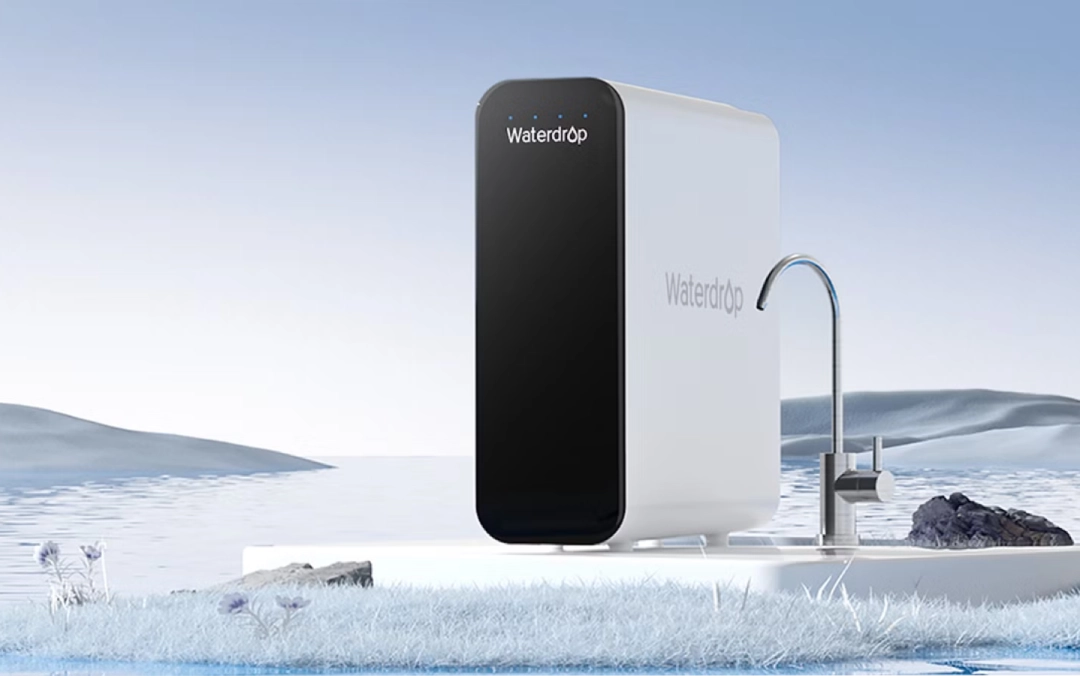
Two machines, one shelf, $140 between them. That is the whole decision.
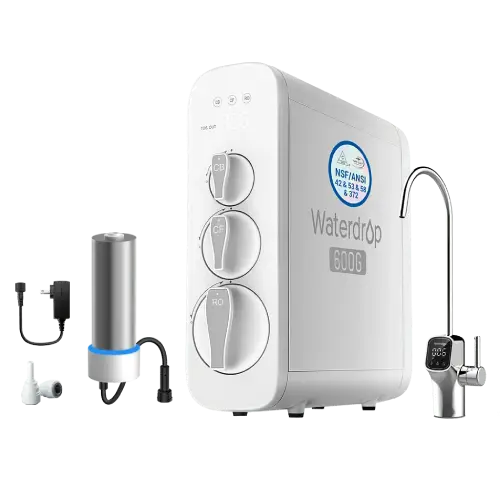
Both are tankless, both sit under the sink, both carry the same four NSF certifications, and both come from the same brand in the same year. This Waterdrop G3P600 vs G3P800 comparison is really an argument about whether two extra stages and 200 extra gallons a day are worth the difference.
The Two Machines Side by Side
| Spec | G3P600 | G3P800 |
| Price | $459 | $599 |
| Daily output | 600 gallons | 800 gallons |
| Filtration stages | 8 | 10 |
| Stated pure to drain | 2 to 1 | 3 to 1 |
| UV sterilisation | Yes | Yes |
| TDS display | Yes | Yes |
| Tank | Tankless | Tankless |
| Certification | NSF/ANSI 42, 53, 58, 372 | NSF/ANSI 42, 53, 58, 372 |
Look at the fifth row, then look at the bottom row. The waste ratios differ. The certifications do not.
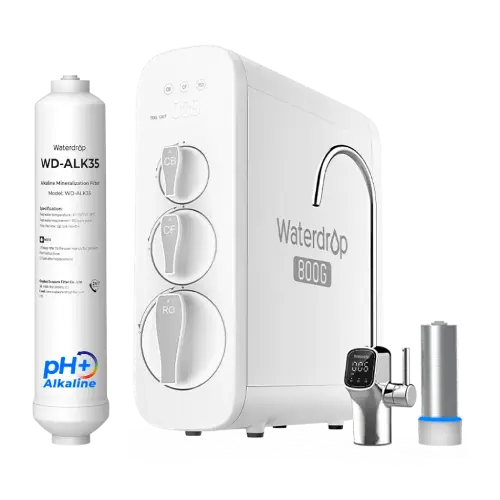
Almost everything else is shared. Ultraviolet sterilisation on the outlet, a live total dissolved solids readout on the faucet, no storage tank anywhere in the design, and the same NSF/ANSI 42, 53, 58 and 372 certifications covering taste, contaminant reduction, reverse osmosis performance and lead free materials.
That certification overlap matters more than the stage count does, because a stage is whatever the manufacturer decides to call a stage while a certification is a third party testing the outlet water against a published standard.
Breaking Down the Gap
Here is the $140, itemised.
| What the $140 buys | Figure | Worth it? |
| Extra daily output | 200 gallons | Only if you are waiting |
| Extra filtration stages | 2 | Marginal on the same certs |
| Cost per gallon per day | $0.765 vs $0.749 | Almost identical |
| Certifications gained | None | Both carry the same four |
Per gallon of daily capacity the two machines cost almost exactly the same. You are buying volume, not quality.
Six hundred gallons a day is already an absurd number for a household. A family of four drinking and cooking heavily might get through four or five gallons in a day, which means the smaller machine is running at under one per cent of its rated capacity and the larger one is running at even less than that.
What daily output really controls is flow rate at the tap. More gallons per day means a faster stream and less standing there holding a jug, and on a tankless RO that is the only thing the number practically affects for most households.
Two extra stages sounds like more filtration. On identical certifications it more often means the same job split into more cartridges.
The Waste Ratio Nobody Can Explain
This is the part that cost the brand two points, and it is worth reading slowly.
| Reading of 3 to 1 | Waste share | Wasted per year |
| Three pure to one drain | 25% | About 122 gallons |
| One pure to three drain | 75% | About 1,095 gallons |
| Difference on one machine | 50 points | 973 gallons |
The same machine, the same published ratio, read two different ways by two credible outlets. The gap is 973 gallons a year.
The G3P800 is sold on a three to one ratio. One well known home reviews outlet reads that as three cups filtered for every cup sent to the drain, which is 25% waste. A specialist water filtration site reads the identical figure as three parts drained per part filtered and publishes an annual waste of 1,095 gallons, which is 75%.
Both cannot be right, and the difference is not academic. At one gallon of drinking water a day, one reading throws away roughly 122 gallons a year and the other throws away 1,095, which is the difference between a rounding error on your water bill and a genuinely wasteful appliance.
- Waterdrop markets the ratio without spelling out the direction
- Convention in the industry is pure to drain, favouring 25%
- But the smaller G3P600 is sold as two to one, which would be worse
- A model upgrade that worsens efficiency makes no commercial sense
That last point is the tell. If both ratios are read as pure to drain, the G3P800 at three to one is better than the G3P600 at two to one, and a newer flagship improving on its predecessor is exactly what you would expect, which makes 25% the likelier reading even though nobody has stated it plainly.
Ask before you buy. It is one email and it settles a thousand gallons a year.
What Both Machines Get Right
Credit where it is due, because the underlying hardware is good.
- Under an hour to install with no plumber
- Tankless, so nothing sits stagnant in a bladder
- Measured output around 8 PPM on a real install
- Filter change is a twist, not a shutdown
Eight parts per million is genuinely low. Municipal tap water commonly runs anywhere from 150 to 400, so a reading that far down is the reverse osmosis membrane doing precisely what it is sold to do, and it is measurable on the faucet display rather than taken on trust.
The tankless design also removes the single most common complaint about older systems, which is a pressurised tank slowly growing biofilm under a sink where nobody looks at it for six years.
The Two Real Drawbacks
Neither is a dealbreaker. Both are worth knowing.
The filters are proprietary, so a Waterdrop reverse osmosis system locks you into Waterdrop cartridges for the life of the appliance, and that running cost is not in the sticker price you compared at the checkout.
Owners also consistently report an audible groan from the pump while dispensing. Not loud, not a fault, but present, and in an open plan kitchen it is the kind of noise you notice for the first fortnight.
Which One to Buy
Buy the G3P600 at $459. For nearly every household it is the same water, the same certifications and the same tankless design for $140 less, and the capacity you are giving up is capacity you will never approach.
Buy the G3P800 at $599 only if flow rate at the tap genuinely irritates you, if you are filling large containers routinely, or if you run a small commercial kitchen where 800 gallons a day is a real figure rather than a specification sheet flourish.
Final Verdict
| Category | Score |
| Filtration And Certification | 9 / 10 |
| Tankless Design | 9 / 10 |
| Installation Simplicity | 8.5 / 10 |
| Filter Cost Lock In | 5 / 10 |
| Waste Ratio Clarity | 4 / 10 |
| Overall Score | 8 / 10 |
Both machines earn eight out of ten and the recommendation goes to the cheaper one. Four NSF certifications shared across both models, a tankless design, an under an hour install and a measured 8 PPM at the tap is a strong package at either price, and the per gallon cost of capacity is within two cents between them. What holds the score down is a proprietary filter lock in and a published waste ratio that two credible sources read in opposite directions, a 973 gallon a year disagreement about the same appliance. Anyone weighing up Waterdrop G3P600 vs G3P800 should email the brand for the direction of that ratio before ordering either one.
FAQs
What is the price difference?
$459 for the G3P600 and $599 for the G3P800, a $140 gap.
Is the G3P800 better filtered?
It has ten stages against eight, but both carry identical NSF/ANSI 42, 53, 58 and 372 certifications.
How much water do they waste?
Published as two to one and three to one respectively. The direction of those ratios is not stated clearly, and the two readings differ by about 973 gallons a year.
Do they need a plumber?
No. Most owners report under an hour for a straightforward under sink install.
Are the filters expensive?
They are proprietary, which is the real long term cost of any tankless RO system and worth pricing before you buy.
Which one should most people buy?
The G3P600. The extra 200 gallons a day is capacity almost no household will use.
Pricing, specifications and certification listings were accurate at the time of writing and change often. The waste ratio discrepancy described here reflects a genuine conflict between two published third party sources rather than a measurement we have taken, and neither figure has been verified by us. Confirm current pricing, filter costs and the pure to drain ratio with the manufacturer before ordering.
Do you agree with our review?
Comments (0)
All comments are reviewed and approved by an admin before appearing publicly.
No comments yet - be the first to share your thoughts.
Ask a Question
Got a question about this review or the brand? Ask below - our team answers what we can, and it'll appear here for other readers too.